
Signol Labs exists to fix that.
Most workforce systems—job boards, ATS platforms, talent marketplaces—are still operating on thin, inconsistent signals. Resumes, job descriptions, and fragmented data are doing more work than they were ever designed to do. As a result, decision-making is slower, less reliable, and increasingly difficult to trust.
We work with the organizations building, operating, and connecting the workforce ecosystem—from education and training providers to employment platforms to state infrastructure—so data can move, connect, and create value where it matters.
THE PROBLEM
The world is rapidly becoming data-driven, but in education and hiring, we’re still operating on documents.
Resumes and job descriptions have been digitized, but not redesigned. We’ve taken paper and moved it onto screens without changing what the system is actually reading.
That creates a growing gap. As systems become more intelligent—especially with AI—the inputs they rely on remain inconsistent, unstructured, and difficult to trust.
At the same time, better data is starting to emerge. But it isn’t yet structured, portable, or verifiable in a way that systems can fully use.
So instead of powering decisions, it often sits alongside them—and the system becomes more digital, but not more effective.
THE MODEL
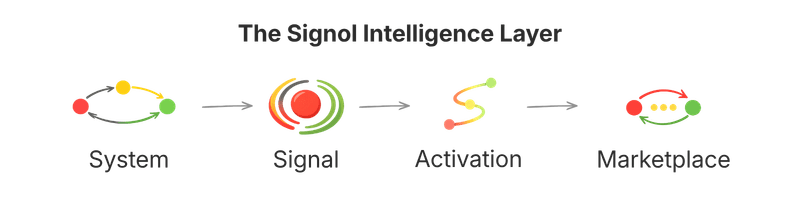
We think about this as a connected system.
Systems are the environments where decisions are made—ATS platforms, talent marketplaces, HR tech.
Signals are the data—credentials, skills, experience, verified information about people.
Activation is what happens when signals become usable inside those systems—when data actually improves matching, evaluation, and decision-making.
Marketplaces are where it all plays out—where better data leads to better outcomes for individuals and organizations.
Most efforts in this space focus on signals.
We focus on how those signals move through systems and become activated.
Because that’s where value is created.
WHO WE WORK WITH
This work doesn’t sit in one part of the ecosystem.
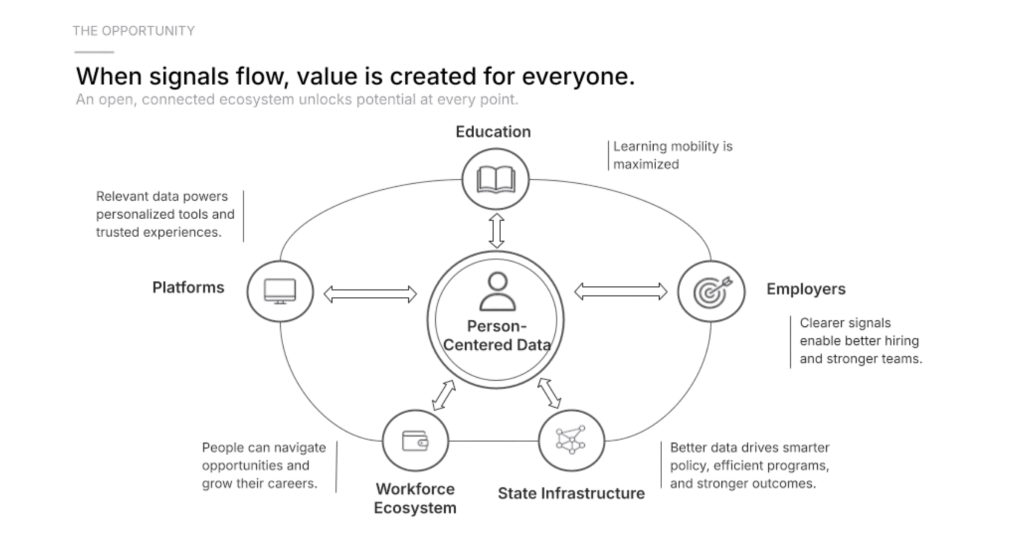
The challenge we’re solving—making workforce data usable across systems—requires working across the organizations that produce data, the systems that consume it, and the infrastructure that connects it.
We typically partner with organizations at different points in that system, depending on where the challenge sits.
We work with education and training organizations to ensure the data they are producing can actually be used downstream. That means going beyond issuance into structure, interoperability, and how that data will move across systems.
We work with employment platforms and technology providers to design how structured workforce data shows up inside their products and workflows—how signals are consumed, interpreted, and used to improve decision-making.
We work with employers to rethink how hiring systems interpret and act on data, enabling better matching, evaluation, and outcomes.
And we work with state and workforce leaders to design the infrastructure that connects these systems—so data can move, insights can be generated, and better decisions can be made at scale.
Different roles. Shared challenge.
Better outcomes when the system is connected.
HOW WE WORK
This work doesn’t start from scratch. It starts with what already exists.
Most organizations we work with have the data, systems, and capabilities they need—they’re just not structured, aligned, or connected in a way that creates value.
Our role is to bring clarity to that complexity, align stakeholders around what matters, and turn that into a path that can actually be executed and scaled.
When signals move across systems and can be trusted, interpreted, and used, the impact isn’t isolated to one part of the ecosystem.
It shows up everywhere.
WHY SIGNOL
This work sits at the intersection of data, systems, and real-world behavior.
Before founding Signol Labs, I spent over a decade building data-driven marketplaces in digital advertising, where decisions were made in real time based on rich, structured data. When I moved into hiring, the contrast was hard to ignore. The systems that shape opportunity were operating on far less data—and far less usable data—than almost any other industry.
That perspective shapes how we approach this work.
Not as a credentialing problem, and not as a messaging problem, but as a system design problem.
LET’S TALK
The opportunity isn’t just to create better records of what people have done.
It’s to make that information usable, trusted, and connected across the systems that actually shape opportunity.
If you’re working on this problem—from any part of the ecosystem—we’d welcome the conversation.


